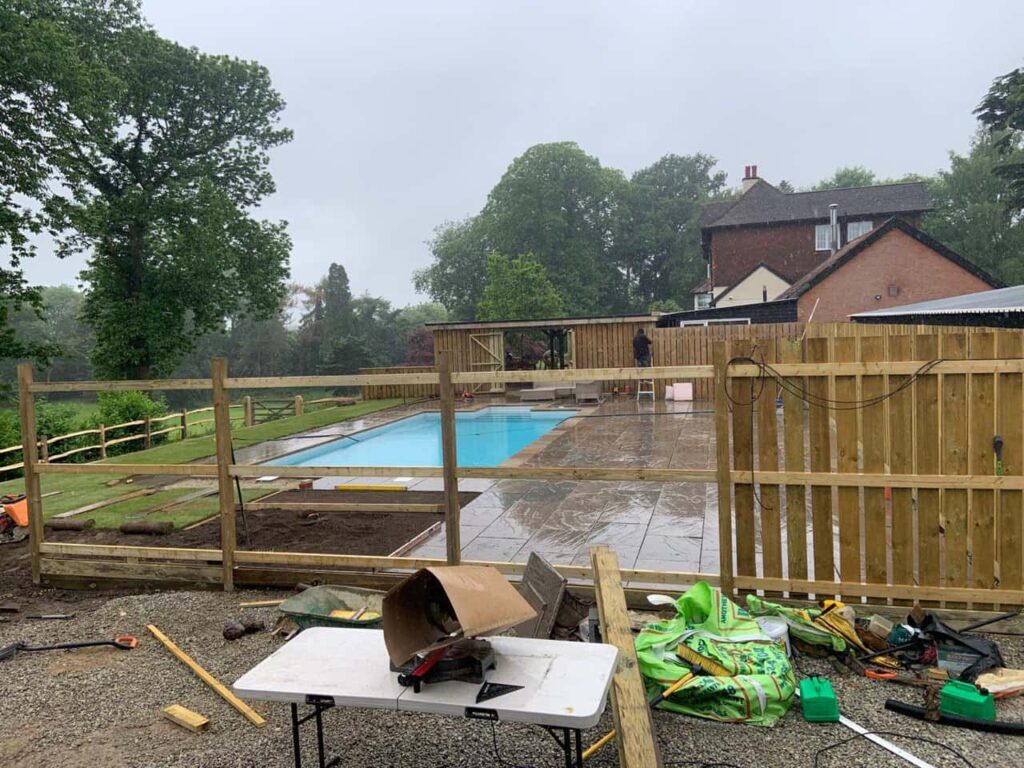
What Makes Feather Edge Fencing Suitable for Long Garden Boundaries?
Long garden boundaries require fencing that can provide consistent privacy, dependable strength and a neat appearance across the entire length. The fence may also need to accommodate changes in ground level, corners and existing garden features without leaving awkward gaps.
Feather edge fencing is particularly well suited to these requirements because it is constructed on site using individual vertical boards. For homeowners in Sevenoaks, Kent, this adaptable method can create a strong, continuous boundary tailored to the garden rather than restricted by standard panel sizes.
Why Feather Edge Fencing Works Well Along Long Boundaries
Feather edge fencing consists of tapered vertical boards fixed with an overlap to horizontal rails, which are supported by securely installed posts. A gravel board is commonly positioned along the base to protect the timber and create a defined lower edge.
This construction produces a solid fence line while allowing the height, length and layout to be adjusted to suit the property.
Continuous Privacy Across the Garden
The overlapping boards form a close, solid barrier without the regular gaps found in more open fencing styles. This can improve privacy along gardens overlooked by neighbouring properties, footpaths or other outdoor areas.
Individual boards can be positioned consistently across the boundary, helping the fence maintain the same level of coverage from one end to the other. Correct overlap is important because boards may shrink or expand slightly as moisture levels change.
When installed properly, the overlap helps prevent visible gaps from developing between the boards.
Strong Construction for Exposed Boundaries
A long fence presents a substantial surface to the wind. Its ability to remain stable depends on more than the thickness of the visible boards.
Feather edge fencing uses posts, rails and boards as one connected structure. Securely positioned posts transfer wind pressure into the ground, while correctly spaced rails support the boards and limit movement.
The following details are especially important:
- suitable spacing between posts
- adequate post depth and support
- correctly positioned horizontal rails
- consistent board overlap
- secure fixings
- stable gravel boards at ground level
If any of these components are poorly installed, movement in one section can place additional strain on the rest of the boundary.
Adaptable to Changes in Ground Level
Many long gardens include slopes, uneven ground or gradual changes in height. Standard fence panels can leave triangular gaps beneath them or create an irregular top line when installed across these conditions.
Because feather edge fencing is assembled board by board, it can follow the ground more closely. The fence may be stepped in controlled sections or adjusted gradually, depending on the gradient and desired appearance.
This flexibility helps maintain privacy and reduces excessive gaps beneath the fence. Careful measurement is still essential so that changes in level look intentional and consistent.
A Neat and Unified Appearance
A continuous run of feather edge boards can give a long garden a more cohesive appearance. Unlike separate panels, which create obvious divisions at each post, feather edge fencing can produce a flowing boundary line.
The finished look can be adapted through the choice of height, capping and gravel boards. Consistent board spacing and alignment are particularly important over a long distance, as small variations become more noticeable when repeated.
A professionally set-out fence helps ensure that the posts remain aligned and that the top of the boundary follows a considered line.
Sections Can Be Repaired Individually
Damage to one part of a long fence does not necessarily mean the entire boundary requires replacement. Individual feather edge boards, rails or gravel boards can often be replaced where the surrounding structure remains sound.
This sectional construction is useful when a small area has been affected by impact, timber deterioration or movement. However, the cause should be identified before repair work begins.
Repeated board failure may indicate a weakened rail, while several leaning sections could point to problems with the posts. Addressing the supporting component provides a more reliable result than replacing only the visible damage.
Gravel Boards Protect the Lower Edge
The base of a fence is particularly vulnerable because it sits close to damp soil, vegetation and surface water. Gravel boards create separation between the feather edge boards and the ground.
As well as protecting the lower edge of the timber, gravel boards help maintain a tidy line along the boundary. They can also accommodate modest variations in ground level and reduce the likelihood of soil building up against the fence boards.
Effective drainage around the base remains important, as persistently wet ground can affect posts and other supporting materials.
Suitable for Gates, Corners and Garden Features
Long boundaries often need to connect with gates, sheds, walls or changes in direction. The adaptable construction of feather edge fencing allows these details to be incorporated without disrupting the overall appearance.
Gate posts require additional stability because opening and closing places repeated pressure on them. Corners also need careful positioning so that the rails and boards remain securely connected.
Planning these features before installation helps create a practical boundary with fewer weak points.
Why Professional Installation Matters
The longer the fence line, the more important accurate setting out becomes. Small errors in post alignment, spacing or height can become increasingly visible and may affect structural stability.
A professional assessment considers the ground conditions, exposure, changes in level and intended fence height before determining the installation method. It also allows existing weak points, drainage concerns and access requirements to be addressed as part of the design.
This preparation gives every part of the fence a clear structural role and helps the complete boundary perform consistently.
Conclusion
Feather edge fencing is suitable for long garden boundaries because it combines privacy, strength and design flexibility. Its board-by-board construction allows it to follow changing ground levels, incorporate gates and corners, and create a continuous appearance across the property.
Lasting performance depends on firm posts, correctly spaced rails, suitable board overlap and careful alignment. If you are considering feather edge fencing for your garden in Sevenoaks, Kent, Sevenoaks Fencing Services can assess the boundary and recommend an installation suited to its layout and conditions. Contact our team to arrange a professional assessment.
Call us on: 01732 904 194
Click here to find out more about Sevenoaks Fencing Services
Click here to complete our contact form and see how we can help with your fencing needs.